


To grow a Flame Tree bonsai from seed, first scarify the hard seeds, then soak them in lukewarm water for a few days until they swell. Known around the world as the Royal Poinciana, Flamboyant tree, or even the Fire Tree, Delonix regia is a tropical beauty that comes from Madagascar and has spread to warm regions across Asia, Africa, and the Caribbean.
The swollen seeds are about 1-2 cm deep in a pot with well-draining soil, and keep the soil consistently moist but not overwatered. Germination can take several weeks, but once seedlings emerge, gradually introduce them to more direct sunlight, protecting the delicate first leaves from harsh conditions.
What makes it so loved? It has fiery red-orange flowers, soft fern-like leaves, and bold single-stem growth that quickly fills into a wide, flat canopy. Unlike delicate bonsai like Wisteria bonsai, Sakura bonsai, or Hibiscus, the Flame Tree brings a dramatic, tropical feel to your collection.
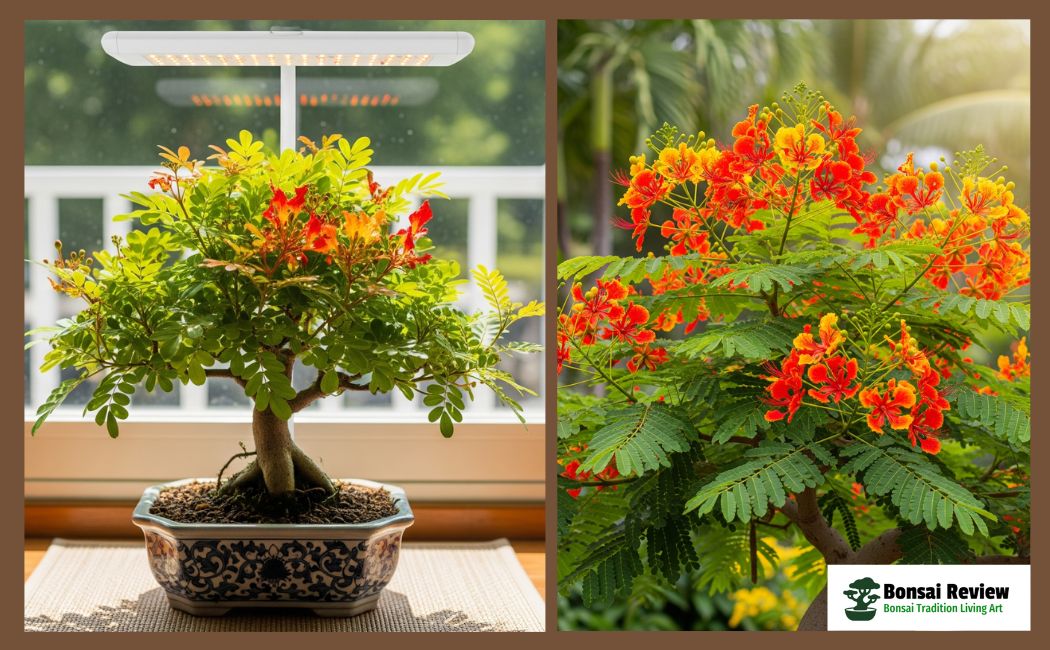
What Makes Flame Tree Bonsai Special?
A flame tree, scientifically known as Delonix regia bonsai is a challenging but beautiful choice that produces large red-orange flowers and fern-like leaves. Key care requirements include ample sunlight, consistent warmth (tropical to subtropical temperatures), protection from wind, well-draining soil, and regular fertilization.
Due to its rapid, single-stem growth and large leaves, creating a finely ramified bonsai with a smaller canopy is challenging.
So, it is best suited for tropical climates or as an indoor plant with supplemental lighting in cooler regions.
The most common flame tree used for bonsai is the Royal Poinciana (Delonix regia), a tropical flowering plant from Madagascar.
One reason bonsai lovers choose this tree is its tropical charm. Unlike a gentle Sakura bonsai or a climbing Wisteria bonsai, the Flame Tree feels bold, alive, and full of energy. In many cultures, it’s seen as a symbol of celebration, passion, and vitality.
The tree also grows fast. In the right conditions, a baby flame tree bonsai can turn into a strong 1-year-old seedling with a thick trunk and wide spread. Its natural habit is to form a flat-topped canopy, which makes it stand out among other bonsai plants.
If you’re looking for something dramatic, the Flame Tree Bonsai is a perfect choice. It’s not small and subtle; it’s a fiery, tropical centerpiece that will make your collection feel exotic.
Flame Tree Bonsai: Can You Master the Fiery Royal Poinciana?
Yes, if you dream of a bonsai that looks like it’s on fire when it blooms, the Flame Tree Bonsai (Delonix regia) is the one for you. It’s also linked to other bright species such as the Illawarra flame tree (Brachychiton acerifolius), Brazilian flame tree, Chinese flame tree (Koelreuteria bipinnata), Peacock flower, Golden shower tree, and Blue Jacaranda, all celebrated for their striking colors.
You can grow a flame tree bonsai from seed, but it needs patience and care. From a baby seedling to a 1-year-old bonsai, it will need strong sunlight (at least 6 hours daily), warm temperatures of 15–30°C, and well-draining bonsai soil.
Regular watering, pruning, and shaping are key to training this fast grower. Because of its large leaves and quick growth rate, making a small bonsai with fine branches is more challenging than with common bonsai plants, but with time, you’ll have a flamboyant bonsai that glows with color and life.

Can You Grow Flame Tree Bonsai Indoors? Expert Tips for Success.
The Flame Tree Bonsai (Delonix regia) is more than just a dwarf indoor plant showstopper. When in bloom, it looks like a canopy of red, orange, or even yellow fire-colored flowers, which is why it’s called the Flamboyant tree.
Flame tree bonsai has soft, fern-like green leaves that add contrast, making the blossoms shine even brighter. Feathery fern-like leaves and bright red or orange flowers make it a striking specimen. As a bonsai, the tree’s natural umbrella shape is often cultivated.
Placement and Light for Flame Tree Bonsai Indoor.
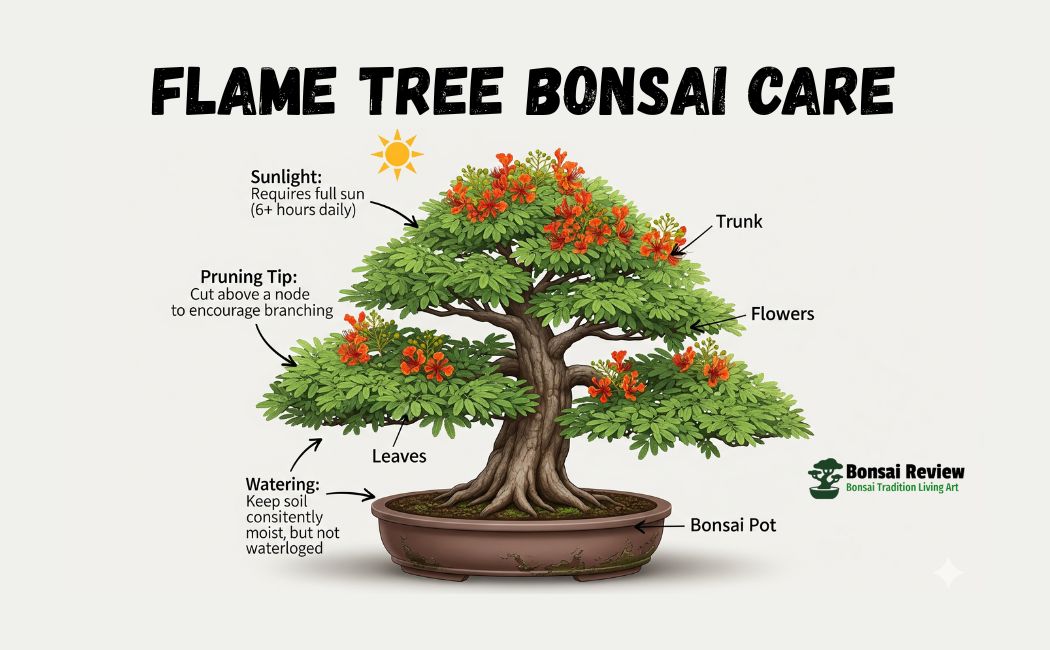
- High Light: Flame trees require at least six hours of direct sunlight daily to produce their showy flowers.
- Temperature & Wind: They are tropical plants that need warm temperatures (15-30°C) and protection from strong winds.
- Indoor Care: In cooler climates, grow flame tree bonsai indoors near a bright, sunny window, as they do not tolerate low light.
Watering and Fertilizing for Flame Bonsai Tree.
- Watering: While they like sun, they need well-draining soil, so avoid overwatering.
- Fertilizing: Repot your flame tree bonsai once it doubles in size or about once a year to replenish soil nutrients.
- Pruning and Shaping Challenges: The primary difficulty in flame tree bonsai is their tendency for fast, single-stem growth and naturally large leaves.
- Pruning Techniques: Pruning is essential to achieve a compact form and encourage inner nodes to sprout, creating a more intricate branch structure.
Climate and Growing Conditions Flame Tree Bonsai
- Tropical/Subtropical: Flame trees are naturally from tropical or subtropical regions.
- Deciduous vs. Evergreen: They are mostly evergreen in tropical climates but can be deciduous in cooler subtropical regions.
- Propagation: Flame trees are typically propagated from seeds that have been soaked in lukewarm water.
The general for Delonix regia is grown worldwide as an ornamental tree and adapted for bonsai use.

Key characteristics for Flame Tree Bonsai from seed to blooming.
- Flowers: The tree produces spectacular clusters of red-orange flowers in the spring and summer. A naturally occurring yellow variety (Flavida) is rarer.
- Leaves: The leaves are doubly compound and have a delicate, feathery appearance. They can reach up to 20 inches long on a full-sized tree, but are smaller and more controlled in a bonsai.
- Trunk and bark: The trunk has a smooth, grayish-brown bark on young trees that becomes rougher with age. It is a fast-growing species that can develop a thick trunk relatively quickly.
- Seed pods: Full-sized seed pods can grow up to two feet long and look out of proportion on a bonsai, so they are typically removed.
- Bonsai care and cultivation: The Delonix regia is a tropical species that requires specific conditions to thrive as a bonsai.
- Placement and temperature: Needs plenty of sun and a warm, wind-protected environment. It grows best in temperatures between 60–85°F (15–30°C) during its growing season.
- It does not tolerate frost: In cooler, non-tropical climates, it must be brought indoors during winter once temperatures drop below 50°F (10°C). It may lose its leaves and become dormant during this period.
- Watering: Requires frequent watering during the summer growing season, but the soil should be allowed to dry slightly between waterings to prevent root rot. Watering should be reduced significantly during the dormant winter period.
- Soil and fertilizing: Use a well-draining soil mix that is slightly acidic. During the growing season, fertilize weekly with a balanced liquid fertilizer or every four weeks with a solid organic one.
- Pruning and shaping: This species grows vigorously and can be hard-pruned in early spring. Consistent trimming is necessary during the summer to maintain its shape and promote ramification.
- Wiring can be used to shape older branches: Since the branches can thicken quickly, the wiring must be monitored carefully to prevent cutting into the bark.
Propagation Flame Tree Bonsai.
- Best grown from seed: The seeds should be nicked or soaked in warm water before planting to encourage germination.
- Propagation by semi-hardwood cuttings is also possible, but can be slower.
- Pests and diseases: Prone to scale, especially in winter. Caterpillars and shoot borers can also be pests.
Note: Overwatering or cold conditions can lead to root rot.
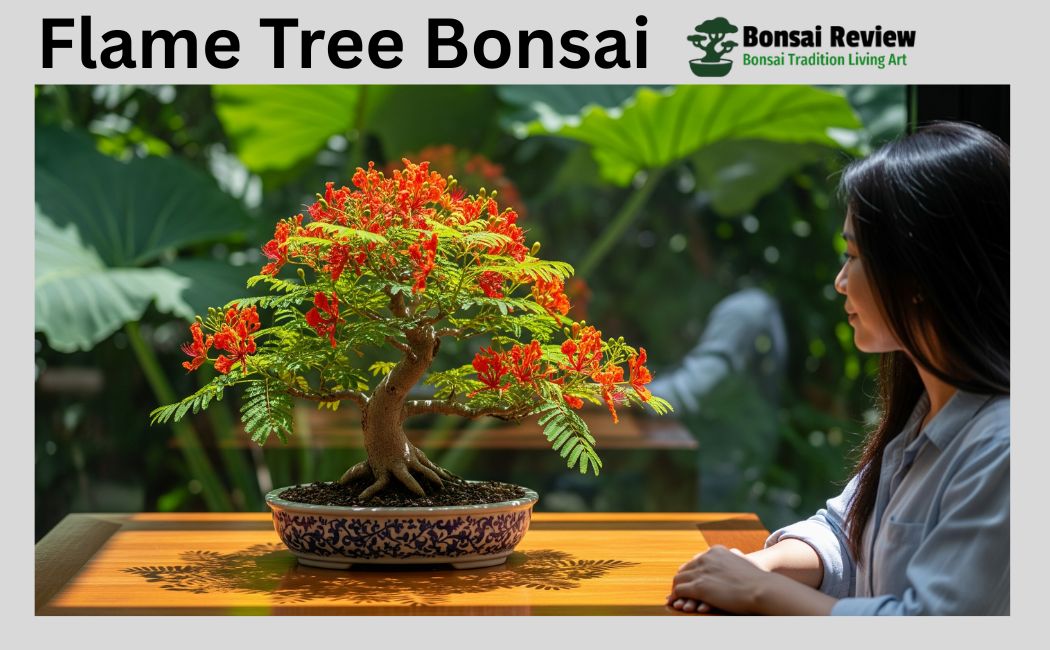
Can You Grow Flame Tree Bonsai at Home?
Yes, you can grow a Flame Tree Bonsai (Delonix regia) at home, but it has special needs. This tree is tropical to subtropical, so it thrives best in warm temperatures between 15–30°C. In its natural home of the Madagascar zone grows tall and wide under full sun, but as a bonsai, you’ll need to give it the same light and warmth.
If you live in a tropical region, you can place it outdoors where it gets at least six hours of direct sunlight daily. In subtropical climates, it may act as semi-deciduous, losing some leaves in cooler months.
In colder places, it’s better to keep your Flame Tree Bonsai indoors near a bright south-facing window or under grow lights, because it cannot survive frost or low light. This bonsai is also sensitive to strong winds, so make sure it’s placed in a sheltered spot.
Outdoors, it shines as a summer bonsai, and indoors, it becomes a striking tropical accent. Whether kept small in a pot or trained into a flat-topped canopy style, the Flame Tree will bring a bold, exotic touch to your home.
How to Grow Flame Tree Bonsai from Seed?
Starting a Flame Tree Bonsai (Delonix regia) from seed is one of the most rewarding ways to grow this fiery tree. The seeds are tough and need a little help before they sprout.
Scarify the hard seed coat by gently nicking it with a file or soaking it in lukewarm water for 24 hours. This softens the shell and makes germination faster.
Once prepared, plant the seeds in a well-draining bonsai soil mix. Keep the soil slightly moist, never soggy, and place the pot in a warm, bright spot. With the right care, seeds usually germinate within 5–12 days.
The growth is quick. In just a few weeks, you’ll see baby seedlings with delicate fern-like leaves. By the end of the first season, you may already have a 1-year-old bonsai strong enough for its first pruning. At this stage, start shaping its trunk and canopy, but keep it gentle, and young stems are tender.
Many growers use bonsai kits that come with bonsai seeds, pots, and soil, making it easier to get started. Whether from a seed packet (like Sheffield’s seeds) or a starter kit, your flame tree bonsai from seed will need light, warmth, and patience to thrive.
Species and Light Needs Flame Tree Bonsai (Delonix regia).
To grow strong and produce Flame tree bonsai is a true sun lover with famous red-orange flowers. It needs at least six hours of direct sunlight daily. Outdoors in a tropical or subtropical climate, it thrives in full sun and quickly develops its bold canopy.
If you live in a cooler region, you can still grow a flame tree bonsai indoors, but it must be placed near a south-facing window where it gets maximum light. If natural sunlight is limited, use grow lights to keep the plant healthy. Without enough light, leaves may turn yellow, growth may slow, and the tree will struggle to bloom.
When placed outdoors, protect your bonsai from strong winds, which can damage young branches. Indoors, rotate the pot every week so the tree grows evenly toward the light.
This bonsai loves warmth (15–30°C) and cannot handle frost. In cold seasons, move it inside before temperatures drop. With the right placement, your Flame Tree Bonsai will reward you with steady growth and, in time, its fiery display of flowers.

How Does Watering and Fertilizing for Flame Tree Bonsai Indoors?
The Flame Tree Bonsai (Delonix regia) loves the sun but doesn’t like “wet feet.” That means you need to keep the soil slightly moist but never waterlogged. A well-draining bonsai soil mix made with sand, pumice, or akadama is best to prevent root rot. Always let the top layer of soil dry a little before watering again.
During the hot growing season, your bonsai may need watering once a day, while in cooler months, watering less often is enough. Always check the soil with your finger before adding water.
For strong growth and bright flowers, feed your Flame Tree Bonsai with a balanced bonsai fertilizer every two weeks during spring and summer. In autumn and winter, reduce feeding as the tree slows down.
Because this species grows fast, it can quickly use up soil nutrients. Many growers choose to repot their flame tree bonsai once a year or whenever the roots begin circling the pot. Repotting not only refreshes the soil but also gives you a chance to trim the roots and keep the tree compact.
Common Problems & Solutions Flame Tree Bonsai Care.
Even experienced growers face challenges with the Flame Tree Bonsai (Delonix regia). Knowing how to spot and fix issues is key to keeping your bonsai healthy and vibrant.
- Yellow Leaves: Often caused by overwatering or poor drainage. Make sure the bonsai soil is well-draining and allow the top layer to dry slightly between watering.
- Weak or Slow Growth: Usually due to insufficient sunlight. Place your bonsai in full sun or near a bright south-facing window indoors.
- No Flowers: Young trees, like baby bonsai or 1-year-old seedlings, may take several years to bloom. In addition, inadequate sunlight or nutrients can delay flowering.
- Root Rot: Happens when the soil stays soggy. Use a bonsai soil mix with sand, pumice, or akadama and ensure proper drainage.
- Leggy or Sparse Branches: Can occur without regular pruning. Trim new shoots to encourage dense branching and maintain a compact canopy.
By understanding these problems and their solutions, your Flame Tree Bonsai can thrive and develop into a fiery, tropical bonsai that displays its signature red-orange flowers.
Flame Tree Bonsai Time Lapse: Watch Your Baby Seedling Turn Fiery?
People also search for: flame tree bonsai alternatives. Growing a flame tree (Delonix regia) into a bonsai is a long-term project that requires patience and consistent care. A time-lapse video would dramatically condense this process, likely showing a fast-growing seedling turn into a small, stylized tree with a woody trunk, but it may take years before it produces the famously fiery blossoms.
A time-lapse is effective for capturing the rapid, early growth phase of a flame tree, which is a fast-growing tropical species.
| Tree / Bonsai | Common Name(s) | Key Features | Ideal Climate | Bonsai Notes |
| Delonix regia | Flame Tree, Royal Poinciana, Flamboyant Tree | Fiery red-orange flowers, fern-like leaves, fast growth | Tropical / Subtropical | Classic tropical bonsai, best for dramatic canopy |
| Brachychiton acerifolius | Illawarra Flame Tree | Bright red flowers, palm-like leaves | Subtropical / Tropical | Can be bonsai, but slower growth, evergreen |
| Delonix floribunda | Brazilian Flame Tree | Red blooms, wide canopy | Tropical | Similar to D. regia, less common in bonsai |
| Koelreuteria bipinnata | Chinese Flame Tree | Yellow-orange flowers, pinnate leaves | Subtropical | Unique color contrast, can be bonsai indoors |
| Caesalpinia pulcherrima | Peacock Flower | Red-orange flowers, delicate leaves | Tropical | Small-leafed, easier bonsai alternative |
| Cassia fistula | Golden Shower Tree | Golden yellow flowers, cascading canopy | Tropical / Subtropical | Striking blooms, suitable for outdoor bonsai |
| Jacaranda mimosifolia | Blue Jacaranda | Blue-lavender flowers, fern-like leaves | Tropical / Subtropical | Adds color variety, moderately fast growth |

Important Considerations for a Time-lapse Flame Tree Bonsai.
Seasonal changes: The time-lapse would capture the tree’s deciduous nature in cooler climates. You would see its fern-like leaves turn yellow and drop in autumn, leaving behind a bare stick for the winter.
Indoor vs. outdoor: If the tree is grown in a climate with frost, the time-lapse would show it being moved indoors for the winter, where its growth may slow or stop.
To care for a Flame Tree bonsai (Delonix regia): Provide full sun and warm temperatures (60-85°F), as it is a tropical plant intolerant of cold. Water regularly, but allow the soil to dry slightly between waterings.
Fertilize with a balanced NPK formula during the growing season. Prune hard in early spring and trim consistently in summer to shape its umbrella crown and promote branching. Use a well-draining bonsai soil and repot every few years, checking for outgrown roots.
Conclusion: Is Flame Tree Bonsai Right for You?
The Flame Tree Bonsai (Delonix regia), also known as Royal Poinciana, Flamboyant tree, or Fire Tree, is a tropical treasure for any bonsai enthusiast. Its fiery red-orange flowers, fern-like leaves, and dramatic canopy make it a stunning centerpiece.
Growing this bonsai from seed or nurturing a 1-year-old seedling takes patience, but with the right sunlight (6+ hours/day), warm temperatures (15–30°C), well-draining bonsai soil, and regular pruning.
Your dwarf tree can thrive indoors or outdoors in tropical and subtropical climates. It is a fast-growing tree with a long lifespan, from 50 to 150 years of age, and can tolerate a wide range of conditions.
While it’s not the easiest bonsai due to fast growth, large leaves, and single-stem habits, the effort is worth it. With proper care, your baby bonsai will gradually develop into a mature, flowering flame tree that brings tropical beauty and fiery color to your space.
For those who love dramatic, exotic bonsai, the Flame Tree Bonsai is a bold and rewarding choice, one that stands out among Wisteria, Sakura, Hibiscus, and other bonsai plants.
Helpful article: How to Grow Bonsai: Expert Tips for Beginners?
FAQs: Why Flame Tree Bonsai (Delonix regia) Is the Tropical Bonsai Everyone Loves?
1. Can you bonsai a Flame Tree?
About Flame Tree Bonsai, bewitching bonsai can be a challenge to maintain, but its awesome foliage makes its demands worth it. Bonsai make for a one-of-a-kind indoor plant offering elegance, nature, and art all in one minute form.
2. How to care for a Flame Tree Bonsai?
Place in full sun (6+ hours/day) or near a bright south-facing window indoors. Use well-draining bonsai soil and water to keep it slightly moist. Fertilize with balanced bonsai fertilizer in the growing season. Regular pruning and shaping encourage dense branching and flowering.
3. Where does the Flame Tree grow?
Native to Madagascar, it thrives in tropical and subtropical climates. It can also be grown indoors in cooler regions under grow lights.
4. Can Flame Tree Bonsai grow indoors?
Yes, but it needs bright sunlight or supplemental grow lights, warmth (15–30°C), and protection from cold drafts.
5. Is Flame Tree the same as Fire Tree?
Yes. The Flame Tree Bonsai is commonly called Fire Tree, Flamboyant tree, or Royal Poinciana. The flame tree likes a sunny, wind-protected place outside during the growing season, as long as the night temperature.
6. How to grow Flame Tree Bonsai from seed?
Soak seeds in lukewarm water for 24 hours to soften the coat. Plant in well-draining bonsai soil, keep moist, and in bright light. Germination takes 5–12 days; baby seedlings grow quickly if cared for properly.
7. How to prune Flame Tree Bonsai?
Trim new shoots to encourage inner nodes and dense branching. Shape the canopy into flat-topped or informal upright styles. Wire branches carefully; they are brittle.
8. How long before a Flame Tree Bonsai flowers?
Typically, 1-year-old seedlings are too young to bloom. Flowering occurs in 2–5 years, depending on care, sunlight, and climate.
9. Can you grow a flame tree from a cutting?
To propagate the Illawarra flame tree, cuttings are the foremost method, taken from a mature stock, ensuring they include a small portion of the older wood at the base. Flame tree bonsai ensures greater stability and improves the chances of successful rooting. Maintaining high humidity and warmth aids in the development of roots.
10. What is the best soil for Flame Tree Bonsai?
Use well-draining bonsai soil mixed with sand, pumice, or akadama. Prevents root rot while keeping the soil slightly moist for healthy growth.